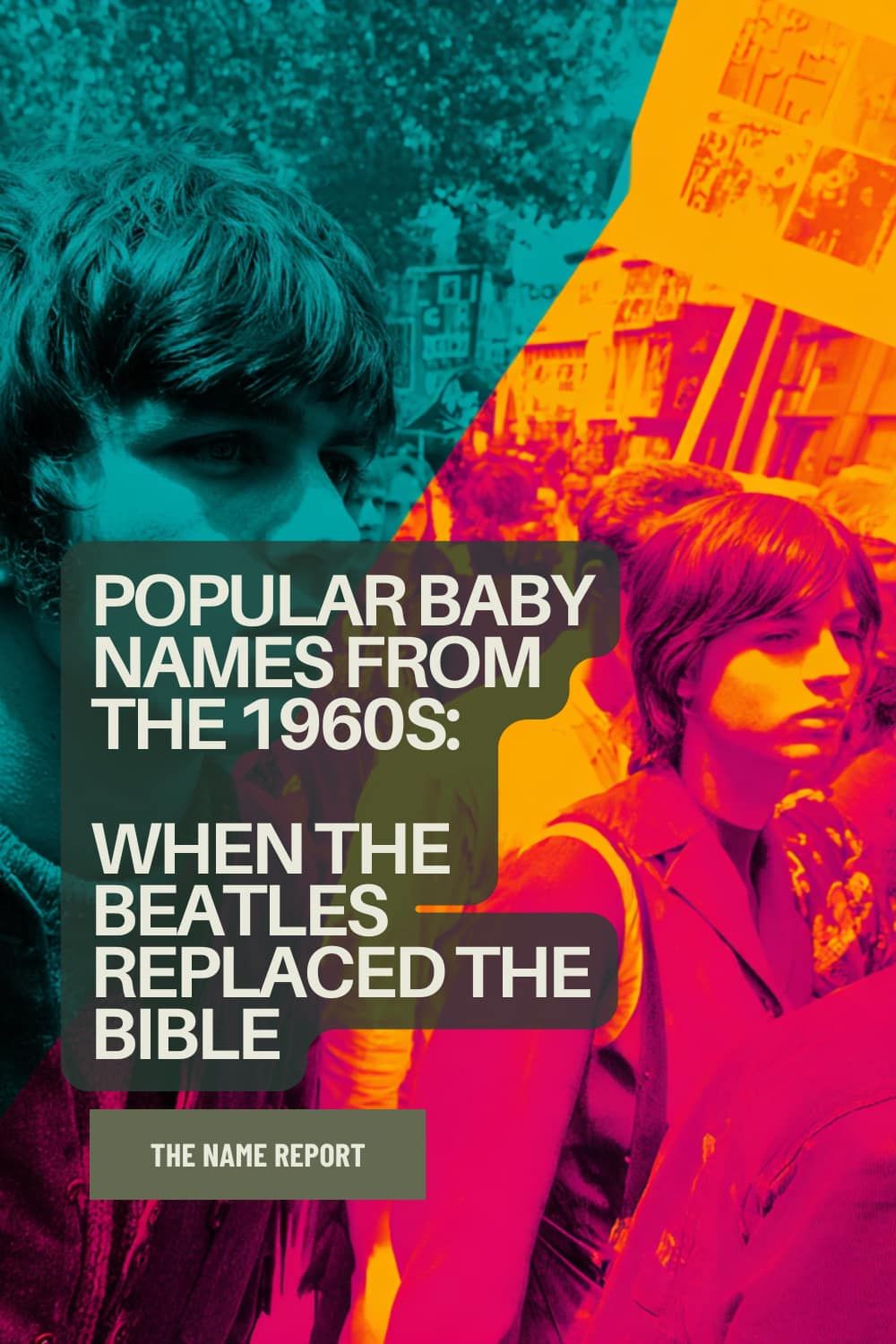
The 1960s didn’t just change music. It changed what parents named their children.
Before the 1960s, American baby naming was straightforward. You chose from a small pool of established, mostly Biblical names. James, John, Mary, Barbara, Patricia. These were the safe choices. The consensus choices. The choices that required no explanation. If you look at the data from the 1930s, 1940s, and 1950s, you see remarkable consistency—the same names dominating decade after decade. Parents weren’t trying to be creative. They were trying to be normal.
Then something shifted. The Boomers started having kids. The Beatles happened. JFK happened. Civil rights happened. Vietnam happened. Second-wave feminism happened. Suddenly, parents weren’t interested in doing what their parents did. They weren’t interested in consensus. They wanted names that meant something different—names that signaled intention, culture, rebellion, or just the fact that they were paying attention to something beyond the Bible and tradition.
By the end of the 1960s, the naming landscape had fundamentally changed. And we’ve never gone back to the old consensus.
The Last Year of Consensus: When Michael Nearly Lost
Here’s something genuinely interesting: 1960 was the one year Michael didn’t hold the #1 spot.
Michael had dominated so completely for so long that it seemed inevitable. But in 1960—just one year, in the middle of the decade, at the very moment cultural shifts were starting—David took the #1 spot. Just that one year. Then Michael reclaimed it and held on until 1999.
But that one year is important. It wasn’t random. 1960 was the year JFK won the presidency. It was the year the civil rights movement was gaining momentum. It was the year the oldest Baby Boomers were starting to come into their own, and the culture was beginning to feel the gravitational shift toward something new. Even naming—the most conservative of cultural decisions—felt it.
David beat Michael for one year. And then the moment passed, and Michael held the line. But something had cracked. Something had shifted. The consensus was just barely beginning to break.
The Lisa Moment: When Girls’ Names Started Looking Different
If David’s one year was the crack in the wall, Lisa was the wall falling down.
Mary had been the #1 girls’ name since the 1880s. Let that sink in. For almost a century, Mary was the default choice for girls. It was Biblical, it was safe, it was what you did. And then, in 1962, Lisa became the #1 girls’ name. Not Mary. Lisa. A name that has no Biblical connection. A name that sounds modern. A name that says something new is happening.
Lisa stayed #1 from 1962 to 1969. For eight years. That’s not coincidence. That’s a cultural shift.
And here’s the thing: Lisa wasn’t an unusual name. It wasn’t edgy. But it represented permission. It represented the idea that you could choose something other than the established pool. That you could name your daughter after a contemporary person (Lisa Gaye, Lisa Marie Presley) instead of a saint or a historical figure. That you could just pick a name because it sounded right, not because it carried centuries of tradition.
Lisa didn’t just replace Mary. Lisa represented the moment when the old naming consensus completely broke.
The Names That Reflected the Decade
The top names from the 1960s tell the story of a culture in transition. Some of the old guard held on. Some reflected the new energy. And some became timestamped to the era so completely that they’re now basically extinct.
The Holdovers:
Michael — Still #1 most of the decade, didn’t lose the top spot until 1999. Even in a decade of rebellion, Michael held. This says something about how truly universal Michael was. It was strong enough to survive the cultural shift. It didn’t require explanation. It worked whether you were traditional or rebellious.
James — Stayed solid. Was #4 in the 1960s, is #4 today. James has this quality where it works across eras. It’s strong without trying, traditional without feeling dated. The Boomers might have rejected their parents’ values, but they kept names like James.
John — Stayed top 5. JFK was a huge cultural figure in 1960, and there was probably a bump in Johns after he was elected. But John was already established enough that it didn’t need the cultural moment. It just kept working.
David — That one year it beat Michael, and then it settled back into strong top-5 territory. David is Biblical, but it’s also contemporary. It works.
The New Energy:
Lisa — The real story. Took over the #1 spot for girls and held it for eight years. Lisa represents the moment when girls’ names stopped being exclusively Biblical and started being contemporary. It’s a watershed moment in naming culture.
Kimberly — Was actually ascending in the 1960s, still climbing. Kimberly is a name that didn’t exist in the previous century’s top names. It’s English (from a place name), but it’s also modern and distinctive. The -ly ending was becoming trendy.
Keith — Peaked in 1966, the same year Keith Richards was absolutely dominating rock music with The Rolling Stones. Parents were naming their kids after rock stars now, not just Bible figures or family names. Keith’s rise is inseparable from the cultural moment.
Cynthia — Was top 10 in the 1950s, stayed relevant into the 1960s (Cynthia Lennon of The Beatles added cultural cache). But it also represents a name that was choosing to be modern. Cynthia is Greek goddess energy—strong, fierce, mythological but not Biblical. By the 1960s, mythology was back on the table as inspiration.
The Extinct:
Karen — Was top 10 in the 1960s. Now basically gone from the top 1000. Karen didn’t just fade—it acquired cultural baggage. The name became slang for an entitled woman, and it’s never recovered. Karen is the cautionary tale of how culture can code a name so completely that it becomes unusable. In the 1960s, Karen was Karen Dalton and Karen Carpenter. Cool, cultural associations. Now Karen is the cultural association.
Donna — Was everywhere in the 1960s, now basically gone. Donna had the same fate as Linda and Susan—it became so overdone that it eventually just felt dated.
Patricia — Was #3 in the 1960s, now completely off the top 1000. Patricia doesn’t have Karen’s baggage, but it has something else: it just sounds like a specific era now. You hear Patricia and you know someone born in a 20-year window. That’s not a compliment in modern naming culture.
Debra/Deborah — Both top 10 in the 1960s, both basically gone now. These were the “safe” girls’ names of the era. When safety stopped being valued, they disappeared.
The In-Between:
Larry, Terry, Gary, Jeffrey — These -ry and -ffy ending names were popular in the 1960s. Now they’re basically extinct. There’s something specifically 1960s about them. They sound like dads. You hear Larry and you see a guy born in 1955 who probably wears a golf shirt.
Judy — Was popular throughout the era (Judy Garland energy), but didn’t carry forward. Judy is a diminutive of Judith, but it never had the staying power of the full name. It’s too specific to its era.
The Gems That Held:
Timothy — Was popular in the 1960s, still works today. Timothy has that quality where it sounds both vintage and contemporary. Tim or Timmy as nicknames keeps it from feeling dated.
Elizabeth — Was given to almost 170,000 girls in the 1960s. Elizabeth Taylor energy. Elizabeth has the staying power of all the truly great names—it’s Biblical, it’s regal, it’s literary. It works.
Patrick — Was given to over 122,000 boys in the 1960s. Patrick is having a moment now, probably because it feels Irish without feeling too ethnic. It’s got substance underneath.
Why the 1960s Changed Everything
The 1950s had consensus. One name (Michael) essentially won. Conformity was the goal. Safety was the goal. You chose from an established pool and that was that.
The 1960s broke that. And the break happened because the culture broke. Parents stopped trusting the values of the previous generation. They stopped assuming that conformity was good. They started looking at what was actually happening—civil rights, Vietnam, feminism, cultural revolution—and they started naming their kids differently.
But here’s what’s interesting: the rebellion wasn’t as radical as you might think. The top 10 names of the 1960s are still pretty traditional. Michael, David, James, Robert, John. Lisa, Mary, Karen, Donna, Patricia. These aren’t wild names. These are still, by modern standards, pretty safe choices.
The real rebellion was in the permission. For the first time, parents felt permission to choose something other than the established pool. Not wildly different, but different. Lisa instead of Mary. Keith instead of another James. Cynthia instead of just Barbara. The changes were subtle, but they cracked open the entire system.
And once the system cracked, it never closed again.
What This Means for the Names That Stayed vs. Faded
The names from the 1960s that have staying power are the ones with actual substance underneath. James, John, David, Elizabeth, Timothy, Patrick—these are names that work because they’re genuinely good, not because they were trendy.
The names that faded are the ones that were popular primarily through cultural consensus. Karen, Donna, Patricia, Debra—these were safe choices. When safe stopped being the priority, they disappeared. They don’t have enough substance to carry them across eras.
And the names that are weird—like Karen—are the ones where the culture itself changed the meaning. Karen was fine until it became a stereotype. Then it became toxic. That’s a different kind of fade.
The lesson from the 1960s is the same lesson from every decade: choose for substance, not trends. But the 1960s is where we see the moment the culture decided that substance mattered more than consensus. Before the 1960s, you chose consensus and called it substance. After the 1960s, you actually had to choose substance because consensus was no longer guaranteed.
For more on how naming culture shifted across decades, check out our analysis of the 1950s, where we saw conformity reach its peak, and the 1940s, which shows how cultural trauma shapes naming. The 1960s is the turning point where parents started rejecting the old model entirely.
You might also appreciate our breakdown ofnames that feel new but are actually very old—because some of the 1960s names that feel contemporary now are actually just names that got permission to exist outside of their era.
And if you’re thinking about how cultural context shapes naming choices, our piece on the hidden class politics of baby naming explores how names signal identity and values. The 1960s is the decade parents started actively choosing names to signal they were paying attention to culture.
For comparison with where naming has gone since, check out our framework on how naming culture continues to shift. The changes that started in the 1960s didn’t stop. They accelerated.
The Bottom Line: 1960s Naming Was the First Real Choice
Before the 1960s, naming was something your culture did to you. You chose from an established pool. You made safe choices. You went with consensus.
The 1960s is when naming became something you did. When parents started choosing names that meant something. Names that reflected what they actually cared about—music, politics, culture, rebellion against the old order. Names that weren’t just safe, but intentional.
Some of those names have held up beautifully. James, John, David, Elizabeth, Timothy—these are still solid choices because they have substance underneath. Some of them became dated because they were trendy rather than substantive. Karen, Donna, Debra—they were popular because everyone was choosing them, and when everyone stopped, they became timestamps.
But all of them represent the moment when parents stopped just doing what their parents did and started choosing for themselves. That moment changed everything about how we name our kids. And we’re still living with the consequences—which is good, because it means we get to actually choose.
Ready to Find Your Kid’s Perfect Name?
The right name doesn’t require consensus. It requires intention. It requires you to actually think about what you’re choosing and why.
Get Your Personalized Name Report and discover which names actually fit your family—whether that means holding onto classics with substance like James and Elizabeth, or finding something that breaks the pattern intentionally. Because the best names aren’t chosen by accident. They’re chosen by people paying attention.