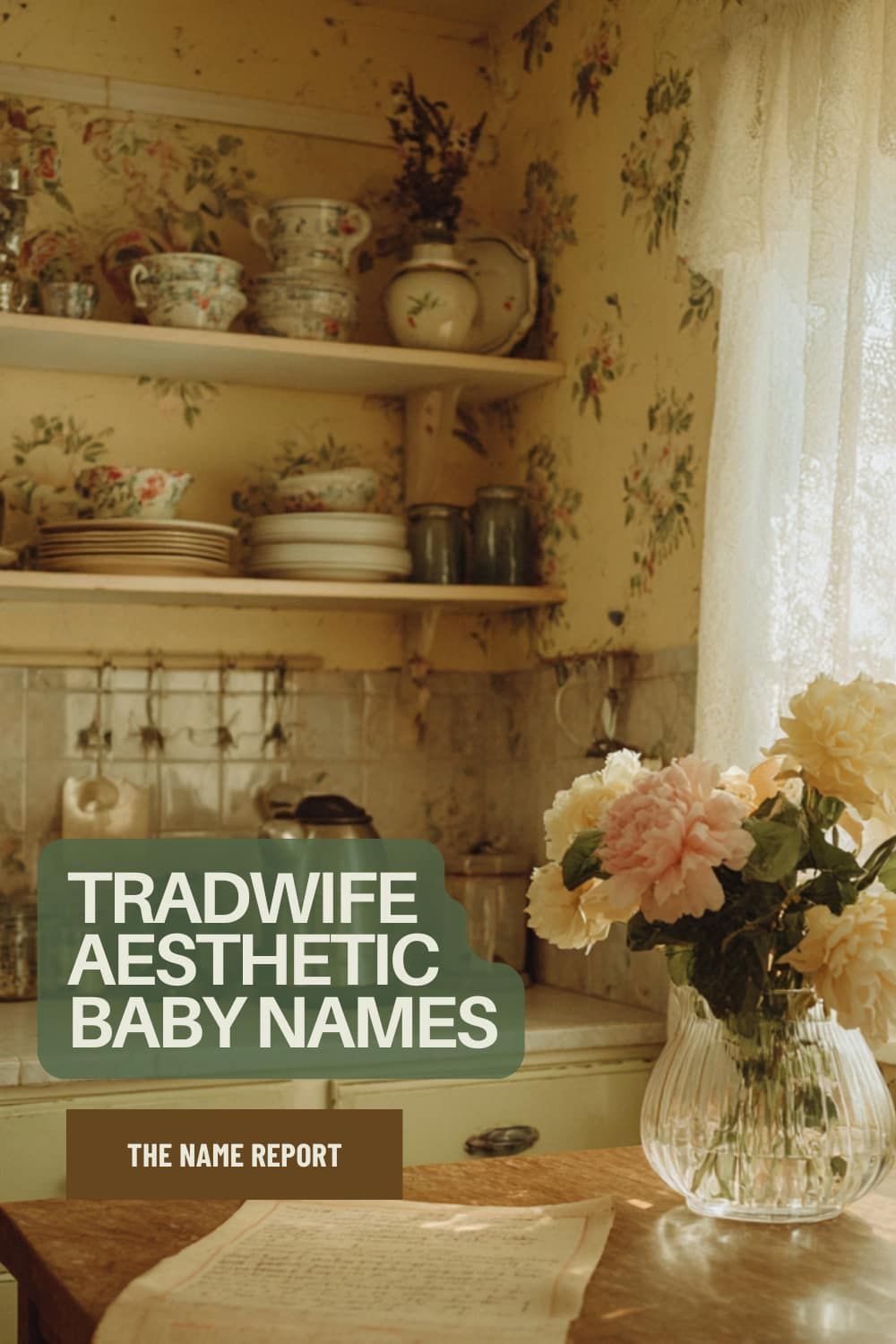
The tradwife aesthetic was everywhere in 2025. The soft-focus videos, the vintage dresses, the sourdough starter, the children playing quietly in the background while she cans vegetables. Whether you think it’s empowerment or performance, nostalgia or ideology, one thing is undeniable: it’s a visual and cultural aesthetic, and like all aesthetics, it communicates through naming.
The names parents choose when they’re drawn to tradwife aesthetics aren’t random. They’re signaling something specific: a particular vision of femininity, family, and cultural continuity. Some of these names are genuinely beautiful and culturally rooted. Some are newly invented or revived for specifically contemporary reasons. Understanding what these names communicate—not whether that communication is good or bad, but what it signals—is cultural work.
This post is about the names themselves, not the politics. But naming always carries cultural weight, so we won’t pretend it doesn’t.
The Softly Feminine Names: Gentle Softness
Eleanor (EL-uh-nor; Greek/French: “bright light” or “torch”) — Eleanor is everywhere in tradwife aesthetics, and for good reason. It’s feminine without being cutesy, classic without being dated, and it carries genuine historical weight (Eleanor Roosevelt, Eleanor of Aquitaine). The name suggests someone thoughtful, literary, strong enough to wear an apron without disappearing into it. It’s the name of a woman who has opinions, but announces them softly. Like names in dark academia contexts, Eleanor carries intellectual weight underneath the softness.
Hazel (HAY-zul; English: hazel tree) — Hazel is the tradwife aesthetic name. Short, nature-coded, vaguely witchy, domestically grounded. It works because it’s simultaneously modern (it’s been rising in popularity for a decade) and vintage (it was extremely popular mid-century). Like many cottagecore names, Hazel sits at the intersection of nostalgic and contemporary. Parents choosing Hazel for a tradwife context are selecting something that feels both authentic and intentional.
Iris (EYE-ris; Greek: rainbow, goddess of the rainbow) — Short, botanical, old-fashioned without trying. Iris reads as someone who grows things, makes things, pays attention to small details. Flower names are experiencing genuine renaissance, and Iris anchors that trend with classical mythology while staying grounded in actual botanical meaning rather than surface aesthetic.
Violet (VY-uh-let; Latin: “purple flower”) — Violet is flower-coded in the most obvious way, which is partly why it works—no subtlety required. Parents choosing Violet are announcing commitment to a soft, nature-connected aesthetic. The Violet revival (it was #7 in 2024 popularity) shows how completely the tradwife aesthetic has normalized these names across all contexts.
Grace (grace; Latin: “grace, elegance”) — The virtue name, historically used by religious and conservative families. Grace works in tradwife contexts because it’s both a quality and a name—it signals what the parent hopes the child will embody. Simple, direct, requiring no explanation.
Rose (rohz; Latin: rose flower) — The most direct flower name. Rose appears constantly in tradwife content because it’s simultaneously simple and loaded with meaning: romance, English gardens, cottage aesthetics. Single syllable, unadorned, complete.
Clara (KLAR-uh; Latin: “bright, clear”) — Clara is the name of a woman who is organized, thoughtful, intelligent. It avoids cuteness while remaining thoroughly feminine. The historical weight (Clara Barton, Clara Schumann) gives it substance without requiring explanation.
Josephine (JO-suh-feen; Hebrew: “God increases”) — Longer, more elaborate, allowing for the nickname “Josephine” or “Jo.” It’s the name that signals education and taste without being performative about it. Traditionally masculine (Joseph) feminized through a standard suffix, which makes it feel both classical and intentional.
The Old-Money Names: Inherited Femininity
Margot (MAR-go; French: “pearl”) — Margot is doing aesthetic work: it’s European without being foreign, elegant without trying, wealthy without announcing it. It reads as old money precisely because it’s uncommon enough to feel chosen rather than defaulted to. Margot parents are selecting something with genuine cultural history.
Beatrice (BEE-uh-tris; Italian: “she who brings happiness”) — Beatrice is literary (Dante), historical (royal lineages), and literary again (Shakespeare). It’s long enough to require intention, feminine enough to be unquestionable, cultured enough to signal taste. The nickname “Bea” offers softening without the name losing its substance.
Evelyn (EV-lin; English: “desired, wished for”) — Evelyn reads as generational—it was popular mid-century, disappeared, and has been experiencing genuine revival. Parents choosing Evelyn are selecting something that ages well across contexts and time periods. It works because it’s simultaneously old-fashioned and contemporary-sounding.
Matilda (muh-TIL-duh; Germanic: “mighty in battle”) — The contradiction in Matilda is what makes it interesting: it means “warrior” but sounds soft and domestic. It’s the name of someone who has quiet strength. The nickname “Tilly” adds softening without sentimentality.
Dorothy (DOR-uh-thee; Greek: “gift of God”) — Dorothy is specifically 1940s-50s, which makes it either vintage-coded or explicitly tradwife-coded depending on context. It’s making a statement about when you’re pulling from. Dorothy parents are choosing something that explicitly references mid-century domesticity.
Constance (KON-stuns; Latin: “constant, steadfast”) — Constance is the virtue name that’s aging well. It suggests someone dependable, thoughtful, perhaps not trendy but genuinely present. The meaning is explicit: constancy, loyalty, steadfastness.
The Virtue & Value Names: What You’re Committing To
Hope (hope; English: hope) — The virtue name, explicitly religious or spiritually resonant. Hope signals that the parent is naming aspirationally, that the child represents something the parent values. Single syllable, unadorned, direct.
Faith (fayth; English: faith) — Faith is simultaneously virtue name and explicitly Christian-coded (though not exclusively). It’s the name of commitment to something beyond immediate material reality. It appears frequently in religious tradwife contexts.
Charity (CHAR-uh-tee; English: charity, love) — The least common of the virtue names now, which means parents choosing it are making a specific statement. Charity is explicitly about giving, service, putting others first—all values embedded in tradwife ideology.
Verity (VER-uh-tee; Latin: truth) — Verity is the intellectual virtue name. It suggests someone who values truth above comfort, which is interesting in tradwife contexts because it creates productive tension: what’s being valued? What’s being signaled?
Mercy (MER-see; English: mercy) — Mercy is explicitly about compassion, about forgiveness. It’s a name that centers emotional and relational work rather than individual achievement.
The Heritage Names: Continuity & Connection
Margaret (MAR-guh-ret; Greek: “pearl”) — Margaret carries real historical weight. Multiple queens, literary figures, saints. It’s the full version of Maggie or Margot, offering both substance and diminutive flexibility. It’s traditional without being trendy.
Catherine (KATH-rin; Greek: “pure”) — Catherine is similarly weighted historically. Multiple spellings (Catherine, Katherine, Kathryn) offer flexibility. It’s been continuously used for centuries, which gives it particular power in tradwife contexts: this is continuity, not costume.
Elizabeth (ee-LIZ-uh-beth; Hebrew: “God’s oath”) — Elizabeth carries monarchical and religious weight. It’s been continuously used across centuries, cultures, and classes. Choosing Elizabeth is choosing something with undeniable historical substance.
Frances (FRAN-sis; Latin: “free”) — The feminine version of Francis, Frances has literary connections (Frances Hodgson Burnett), historical weight, and a meaning that creates interesting tension in tradwife contexts: “free” as in liberty, not as in unconstrained.
Dorothy (already listed above) — Worth noting again because it’s so explicitly mid-century coded.
The Names to Understand: Quick Framework
Aesthetic Signals These Names Are Making:
- Softness without weakness
- Femininity that’s cultivated, not accidental
- Connection to nature (flowers, gardens)
- Historical continuity (using old names matters)
- Virtue or value-centered (meaning through qualities rather than uniqueness)
- Literary or cultural weight
- Old-money aesthetics (understated, never announcing itself)
- Family/generational connection
What’s NOT Happening in Tradwife Naming:
- Invented names or extreme uniqueness
- Gender-neutral naming (these are explicitly feminine)
- Modern invention (they’re pulling from history)
- Performance of individuality
- Trendy contemporary sounds
The Cultural Intelligence Question: What Are You Actually Signaling?
Here’s where this gets interesting from a naming perspective. If you’re drawn to these names, it’s worth asking: Why?
Are you genuinely drawn to the aesthetic of soft femininity and historical continuity? Or are you signaling alignment with specific values (family-centeredness, motherhood as primary identity, traditional gender roles)?
Understanding your own name clustering and aesthetic preferences is the first step to authenticity. These aren’t the same thing. You can love the name Eleanor without endorsing the full tradwife ideology. You can appreciate soft, botanical, historically-rooted femininity without believing women should be stay-at-home wives.
But naming always signals something. When you choose Eleanor or Hazel or Violet, you’re participating in a naming tradition that’s become culturally associated with a specific aesthetic and set of values. That’s not bad—all naming carries cultural weight. But it’s worth being honest about what you’re communicating.
The Consideration: Authenticity vs. Aesthetic
The tension with tradwife naming is the same tension Dodai Stewart’s voice at The Name Report identifies constantly: the gap between surface aesthetic and actual values.
Some parents choosing these names genuinely live versions of the tradwife lifestyle—they’re stay-at-home mothers, they garden, they prioritize family, they value continuity. For them, the naming is authentic; the aesthetic reflects actual practice.
Other parents choose these names because they like the sound and feeling of soft, historical femininity without necessarily endorsing the full ideology. They might work, they might co-parent equally, they might have values that don’t align with tradwife philosophy—but they like what Eleanor or Hazel feels like.
Both are legitimate. But the distinction matters, especially when you understand how names signal class and values across different communities. A name is not a costume, but it does communicate. Be honest about what you’re actually signaling versus what the aesthetic suggests you might be.
The Names Worth Reconsidering
A note: some names in tradwife contexts are becoming so explicitly coded that they risk becoming timestamps or aesthetic markers rather than genuine name choices. Dorothy, in particular, is becoming so mid-century-specific that it’s starting to feel less like a name choice and more like a costume choice.
Names like Eleanor, Hazel, Iris, and Grace have enough genuine multi-generational use and cultural weight that they work beyond any single aesthetic. They’re names first, aesthetic signifiers second.
The difference matters. Choose names that work as names, not just as aesthetic props.
Ready to understand what your naming choices actually communicate?
Get a Personalized Name Report that goes beyond surface aesthetics to explore the real values embedded in your naming preferences. Are you drawn to historical continuity? Soft femininity? Specific ideologies? Understanding your own naming logic is the first step to choosing names authentically. Find Your Perfect Name