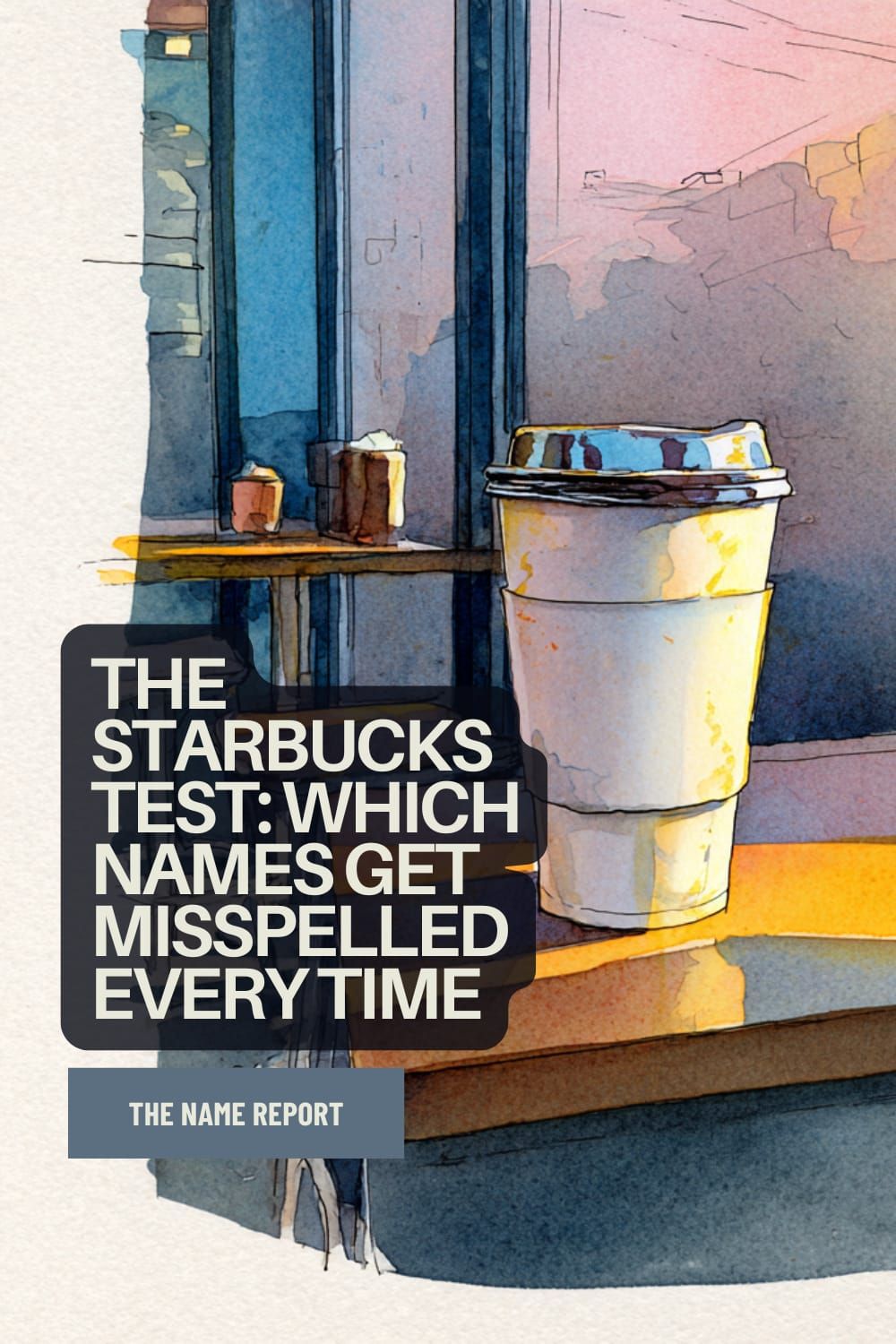
Here’s a naming problem nobody discusses but everyone with an unusual name knows intimately: the Starbucks Test.
This is the moment when you give your name to a barista and watch them write it down. Will they get it right? Will they come back with a completely mystifying variation? Will your child spend their entire life correcting the spelling of their own name?
The Starbucks Test is simple: can a stranger spell your name correctly on the first try without asking for clarification? If not, you’ve failed the test, and your child will be living in a lifetime of misspellings.
This matters more than you think. It’s not just about coffee orders. It’s about accessibility. It’s about whether your child will spend their life as a walking correction or whether their name will just… work.
Why the Starbucks Test Matters
The Starbucks Test measures something crucial: orthographic accessibility. It’s asking: can this name be spelled phonetically by someone who’s never seen it before?
This matters because:
For your child’s entire life, they’ll be spelling their name. At doctor’s offices. At schools. Online. At jobs. Every single time someone new encounters their name, there’s a moment of uncertainty. Either they get it right (name passes the test) or they don’t (name fails, and your child has to correct them).
It’s a form of access. Names that work across contexts are more accessible. They don’t require constant explanation. They don’t create barriers. Your child isn’t managing their own identity.
It shapes how your child experiences their name. Names that age well are ones that don’t become liabilities. A name that fails the Starbucks Test repeatedly becomes a minor liability every single day.
It’s a class signal. Interestingly, names that pass the Starbucks Test tend to signal different things than names that fail it. This matters.
Names That Consistently Pass the Starbucks Test
Single-Syllable Names (Nearly Impossible to Misspell):
Grace (GRAYSS) — One syllable, phonetic, obvious spelling. Nobody misspells Grace. Ever. This is the kind of name that just works.
James (JAYMZ) — One syllable, standard spelling, nobody questions it. James always passes.
Rose (ROHZ) — One syllable, simple and substantial, nobody misspells it. This is reliability.
Ruth (ROOTH) — One syllable, biblical, clear spelling. Ruth passes every time.
Jack (JAK) — One syllable, common, obvious. Jack never fails the test.
Two-Syllable Names with Obvious Phonetics:
Emma (EM-uh) — Two syllables, double M standard spelling, everybody knows this. Emma passes.
Henry (HEN-ree) — Two syllables, clear H-E-N-R-Y spelling, nobody gets confused. Henry passes.
Eleanor (EL-uh-nor) — Three syllables but phonetically clear. Eleanor has standard spelling. It passes.
Hazel (HAY-zul) — Two syllables, botanical but straightforward spelling. H-A-Z-E-L. Hazel passes.
Oliver (AHL-i-ver) — Three syllables, common, clear spelling. Oliver passes every time.
Margaret (MAR-gu-ret) — Three syllables, formal and standard. Margaret has been spelled the same way for centuries. It passes.
Thomas (TAH-mus) — Two syllables, T-H-O-M-A-S standard spelling. Thomas never fails.
The Phonetic But Unexpected Spellers:
Samuel (SAM-yoo-ul) — Three syllables, but the spelling is absolutely standard and predictable. S-A-M-U-E-L. Samuel passes because people trust the phonetics.
Benjamin (BEN-juh-min) — Three syllables, very common, very standard spelling. Benjamin passes.
Alexander (al-IG-zan-der) — Four syllables, but it’s so common and so standardly spelled that nobody messes it up. Alexander passes.
Elizabeth (ee-LIZ-uh-buth) — Four syllables, formal, standard spelling across centuries. Elizabeth passes because it’s too well-established to get wrong.
The Names That Are Phonetically Clear But Less Common:
Silas (SY-las) — Two syllables, straightforward spelling. S-I-L-A-S. People might not know the name, but they can spell it phonetically. Silas passes.
Beatrice (BEE-uh-tris) — Three syllables, literary but phonetically very clear. B-E-A-T-R-I-C-E. Beatrice passes.
Violet (VY-uh-let) — Two syllables, color name but completely standard spelling. Violet passes every time.
Iris (EYE-ris) — Two syllables, flower/goddess name, but I-R-I-S is obvious. Iris passes.
Names That Fail the Starbucks Test (Spectacularly)
The Invented-Sounding Names:
Braxton (BRAKS-tun) — Two syllables, but here’s the question: is it B-R-A-X-T-O-N or B-R-A-K-S-T-O-N? The barista will guess wrong. Braxton fails the test consistently.
Jaxon (JAK-sun) — Is it J-A-X-O-N or J-A-C-K-S-O-N or J-A-X-E-N? There’s no way to know phonetically. Jaxon fails every time.
Kaydence (KAY-dens) — Is it K-A-Y-D-E-N-C-E or C-A-Y-D-E-N-S-E or K-A-D-E-N-C-E? Nobody knows. Kaydence fails constantly.
Paisley (PAYZ-lee) — Is it P-A-I-S-L-E-Y or P-A-Y-Z-L-E-Y? The spelling isn’t phonetically obvious. Paisley fails.
Brooklynn (BROOK-lin) — Is it B-R-O-O-K-L-Y-N or B-R-O-O-K-L-I-N-N? The double N at the end breaks phonetic logic. Brooklynn fails the test.
The Phonetically Tricky Names:
Siobhan (shiv-AAUN) — This is the ultimate Starbucks Test failure. The spelling bears no relationship to the pronunciation. Nobody spells it right without instruction. Siobhan fails spectacularly and repeatedly.
Aoife (EE-fuh) — Irish name with completely non-phonetic spelling. A-O-I-F-E looks nothing like it sounds. Aoife fails every time.
Saoirse (SER-sha) — Irish, completely non-phonetic. S-A-O-I-R-S-E looks impossible. Saoirse fails the test constantly.
Fabiola (fuh-bee-OH-luh) — Is it F-A-B-I-O-L-A or F-A-B-Y-O-L-A? The phonetics suggest wrong spelling. Fabiola fails.
Phoebe (FEE-bee) — The PH is the problem. People write F-E-E-B-E instead of P-H-O-E-B-E. Phoebe fails regularly.
The Names That Sound Simple But Aren’t:
Aislinn (ASH-lin) — Looks Irish, is complicated to spell. A-I-S-L-I-N-N? A-S-H-L-Y-N-N? The phonetic spelling doesn’t match. Aislinn fails.
Iliana (ee-lee-AHN-uh) — Is it I-L-I-A-N-A or I-L-Y-A-N-A or I-L-E-A-N-A? The spelling is ambiguous. Iliana fails the test.
Aliana (ay-lee-AHN-uh) — Same problem as Iliana. A-L-I-A-N-A? A-L-Y-A-N-A? It fails.
Zoë/Zoe (ZOH-ee) — Is there a diaeresis? Is it Z-O-E or Z-O-Ë? This fails constantly because people can’t reliably spell the umlaut.
Chloe (KLOH-ee) — The CH makes people uncertain. C-H-L-O-E or K-L-O-E? Chloe fails more often than you’d think.
The Names with Unusual Letter Combinations:
Quinley (KWIN-lee) — The Q is unusual. People write C-W-I-N-L-E-Y. Quinley fails.
Ximena (see-MAY-nuh) — The X pronunciation doesn’t match English expectations. Ximena fails constantly.
Zhora (ZOR-uh) — The ZH combination is uncommon. People write S-O-R-A or Z-O-R-A. It fails.
Xander (ZAN-der) — The X as Z throws people off. They’ll write S-A-N-D-E-R or Z-A-N-D-E-R inconsistently. Xander fails sometimes.
The Pattern: Why Some Names Pass and Others Fail
Names That Pass:
- Standard, traditional spelling
- Phonetically transparent (sound like they’re spelled)
- Common enough that people have seen them before
- Single or double letters (not unusual combinations)
- No silent letters or confusing phonetics
- English-language spelling conventions
Names That Fail:
- Invented spellings or respellings
- Non-phonetic (don’t sound like they’re spelled)
- Uncommon or unfamiliar
- Multiple vowels that could be pronounced different ways
- Silent letters or unusual letter combinations
- Non-English spelling conventions used in English context
The brutal truth: creative spelling is the primary cause of Starbucks Test failure. When you respell a common name (Jaxon instead of Jackson, Kaydence instead of Cadence), you’re guaranteeing that the name will fail the test repeatedly.
What Failing the Starbucks Test Actually Means
For Your Child:
Your child will:
- Spell their name constantly
- Correct people regularly
- Have misspellings on official documents
- Experience small friction every time they encounter bureaucracy
- Know that their name requires explanation
- Possibly develop feelings about constantly having to correct people
This isn’t catastrophic. But it’s real. It’s a daily small thing that adds up.
Class Implications:
Interestingly, Starbucks Test failure has class coding. Names that fail the test tend to be coded as less educated, more working-class, more “trendy.” Names that pass tend to be coded as more educated, more traditionally minded.
This is unfair, but it’s real. A hiring manager unconsciously processes “Jaxon” differently than “Jackson.” Whether they admit it or not.
The Honest Question: Is Failing the Starbucks Test Worth It?
Here’s where it gets complicated. Some parents choose names that fail the test deliberately. They want their child to be distinctive. They want the creative spelling. They accept that their child will be spelling their name forever.
This is a legitimate choice. But it’s worth making it consciously, understanding what you’re choosing.
If you choose Kaydence over Cadence because you genuinely prefer the spelling and you’re okay with daily spelling corrections, that’s your choice to make. But know what you’re choosing.
If you choose Kaydence because you think it sounds better and didn’t realize it would fail the Starbucks Test, that’s worth reconsideration.
Practical Application: Using the Starbucks Test
Before you name your child:
- Say the name out loud.
- Spell it how you think it should be spelled phonetically.
- Check if that matches the actual spelling.
- Ask: Would a stranger spell it right?
If the answer is no, you’ve failed the Starbucks Test. That’s not necessarily bad. But it’s worth knowing.
You can also:
- Test it on friends. Give them the name and ask them to spell it without seeing it written. If they get it wrong, it fails the test.
- Check common misspellings. If the name has traditional alternatives, know what they are (Siobhan vs. Shevaun, Saoirse vs. Sersha).
- Think about written contexts. Your child will write their name. Will they ever misspell it themselves? (Some kids do, if the spelling doesn’t match phonetics.)
Names That Flirt With Failure But Mostly Pass
Sophia/Sofia — Is it S-O-P-H-I-A or S-O-F-I-A? Both are common enough that people usually guess right. It flirts with failure but generally passes because both spellings are well-known.
Catherine/Katherine — Same situation. Both C and K spellings are standard enough that it usually passes.
Claire/Clare — Both are common. Usually passes.
Cecilia/Cecelia — Both exist, but Cecilia is standard enough. It mostly passes.
These names are in a middle zone. They might fail occasionally, but they’re common enough that people usually get them right eventually.
Names That Work
Look, here’s the thing: names should work. They should work across contexts. They should be accessible.
This doesn’t mean your name has to be boring. Grace is simple and substantial. Emma is accessible and literary. Beatrice is sophisticated and unusual while still passing the Starbucks Test.
You can be creative and have your name work. You can be distinctive and have people spell it right. Those aren’t mutually exclusive. You just have to work within phonetic and orthographic logic.
Ready to Test Your Name?
If you’re worried your chosen name might fail the Starbucks Test, the work is understanding exactly what that failure means and deciding if you’re comfortable with it.
Your Personalized Name Report can help you think through how your name works across contexts, including the Starbucks Test and broader accessibility questions.
Get Your Personalized Name Report →
Because your child’s name should work for them, not against them. Every single day.
Related Reading
- Baby Names That Work in Multiple Languages: Raising Global Citizens
- Names That Actually Age Well: From Nursery to C-Suite
- The Hidden Class Politics of Baby Naming: What Your Child’s Name Says About Access
- Baby Names to Avoid in 2026: Why Certain Naming Choices Create Friction
- Baby Names Like Grace: Virtue, Elegance, and Effortless Sophistication
- Baby Names Like Rose: Short, Elegant, and Genuinely Substantial
- Literary Baby Names: Words That Carry Stories