Both are stripped down. Both value intentionality. But minimalist names and Japandi names represent fundamentally different philosophies about what simplicity means.
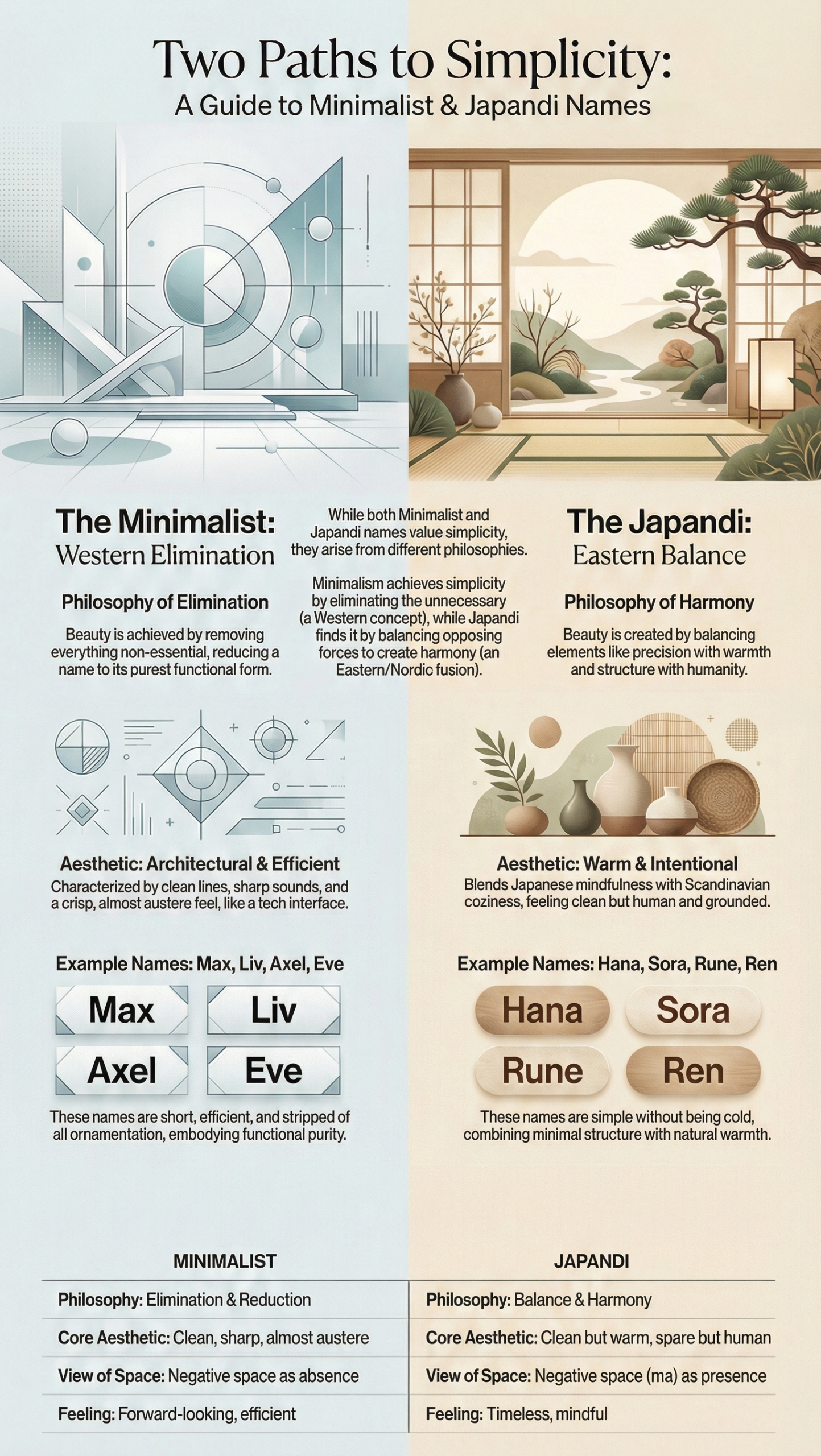
Minimalism is about elimination—removing everything unnecessary until only essence remains. Japandi is about balance—combining Japanese zen with Scandinavian warmth to create harmony. They look similar on the surface but come from different cultural and philosophical traditions.
Understanding the distinction helps you choose names that reflect your actual values about simplicity.
The Core Distinction
Minimalist is elimination-focused. Think clean lines, empty space, architectural precision, Western efficiency. The beauty is in what’s removed—the name is reduced to its most functional form.
Japandi is balance-focused. Think Japanese mindfulness combined with Scandinavian warmth—ma (negative space) paired with coziness, precision with humanity. The beauty is in the harmony between elements.
The names diverge significantly from this foundation.
Visual Comparison Matrix
| MINIMALIST | JAPANDI | |
| Philosophy | Elimination, reduction, functional purity | Balance, harmony, intentional space |
| Cultural Origin | Western (Silicon Valley, Nordic, Bauhaus) | Japanese + Scandinavian fusion |
| Aesthetic | Clean, sharp, almost austere | Clean but warm, spare but human |
| Relationship to Space | Negative space as absence | Negative space (ma) as presence |
| Emotional Tone | Precision, clarity, efficiency | Clarity with warmth, mindfulness |
| Sound Quality | Crisp, short, often monosyllabic | Short but often with softness |
| Names Feel Like | A perfectly designed tech interface | A Japanese garden with Scandinavian coziness |
| Time Association | Contemporary, forward-looking | Timeless, cyclical |
Minimalist Names (Western Elimination, Functional Purity)
These names are reduced to absolute essence. The beauty is in what’s not there—no ornament, no extra syllables, pure function.
Max — Short, efficient, completely stripped down. Minimalist because it’s the name reduced to its most essential form. Works everywhere because there’s nothing to remove.
Kai — Two syllables but feels shorter. Minimalist because it’s all vowels and open space. The name is transparent—no decoration, no hidden meaning (though it has cultural weight from multiple cultures).
Iris — One syllable, sharp, precise. Minimalist because it’s geometric and efficient. The name serves its function without excess.
Leo — One syllable, strong, absolutely no frills. Minimalist because it’s pure power with no ornamentation. Works everywhere because there’s nothing extraneous.
Liv — Three letters, complete efficiency. Minimalist because it’s the absolute minimum necessary to function as a name. Scandinavian efficiency at its most refined.
Axel — Short, sharp, architecture-inspired through its hard consonants. Minimalist because every element serves a function.
Theo — Short, intellectual, stripped to essential. Minimalist because it’s all business—no softness, just pure meaning.
Ash — Three letters, elemental, absolutely reduced. Minimalist because it couldn’t be simpler while still functioning fully.
Bo — Two letters, maximum efficiency. Minimalist because it’s the absolute limit of reduction while remaining viable.
Eve — Three letters, clean lines, one-syllable efficiency. Minimalist through pure simplification.
Japandi Names (Eastern Balance, Intentional Warmth)
These names combine precision with humanity. The beauty is in the balance—removing excess while maintaining warmth and connection.
Hana (HAH-nah) — Japanese, means “flower,” but works through balance—short enough to be minimal, but the vowel sounds create warmth. Japandi because it’s precise without being cold.
Akira (ah-KEER-ah) — Japanese, means “bright,” with clear structure but soft vowels. Japandi because it’s clean-lined but deeply human—there’s intention in the sound.
Sora (SOR-ah) — Japanese, means “sky,” with open simplicity but genuine warmth. Japandi because the negative space (the open vowels) creates balance rather than emptiness.
Yuki (YOO-kee) — Japanese, means “snow,” clean and short but with natural warmth in the sound. Japandi because it’s minimal without being cold.
Rune — Norse origin, short and sharp, but with gentle consonants. Japandi because it balances precision with softness.
Ren (REN) — Japanese/Chinese, means “lotus” or “benevolence,” utterly minimal but profoundly meaningful. Japandi because the simplicity serves balance rather than elimination.
Mika (MEE-kah) — Japanese, means “beautiful fragrance,” short enough to be minimal but with real warmth. Japandi because it combines Scandinavian simplicity with Japanese humanity.
Nora (NOR-ah) — Works across cultures, short and clean, but the vowel sounds create natural warmth. Japandi because it’s stripped down while maintaining accessibility.
Kai (already mentioned) — Works in both categories because it truly bridges minimalism and Japandi—it’s minimal and balanced.
Lina (LEE-nah) — Short, clean, Scandinavian-influenced, but the vowels create warmth. Japandi because it’s functional while remaining human.
How They Connect to Your Framework
Minimalist connects to:
- Architectural Names (clean lines, functional beauty)
- Silicon Valley Minimalist (tech-inspired efficiency)
- Brutalist Architecture Names (stripped to essence)
- Three-Letter Short Names (maximum reduction)
- Midcentury Modern Names (form follows function)
Japandi connects to:
- Japandi Baby Names (the direct category)
- Gentle Gender-Neutral Names (softness with strength)
- The New Nordic Scandinavian Names (Nordic warmth)
- Japanese Names by Meaning (Japanese precision)
- Names That Feel Grounded (grounded through balance)
The Real Difference: Elimination vs Harmony
Minimalism asks: “What can we remove?” The answer is everything that doesn’t serve a function. A minimalist name is pared down to absolute essence. There’s beauty in the emptiness, in negative space as absence.
Japandi asks: “How do we balance?” The answer is combining opposing forces into harmony. A Japandi name is simple but never cold, minimal but always intentional. Negative space (ma) is present, not absent.
Both are philosophies of simplicity. They’re just different kinds of simplicity.
Choosing Between Them
Choose Minimalist if: You’re drawn to efficiency, technological elegance, clean lines, forward-thinking. You want your child to grow up understanding that less is genuinely more, that beauty exists in absence, that function is its own form of beauty.
Choose Japandi if: You’re drawn to balance and harmony, mindfulness, intentional warmth, timeless design. You want your child to grow up understanding that simplicity and humanity can coexist, that constraint creates beauty through balance, that efficiency and warmth aren’t opposites.
Get Your Personalized Name Report
Torn between minimalist and Japandi aesthetics? Want to ensure your simple name choice reflects your actual philosophy? Get your Personalized Name Report at https://app.thenamereport.com/ and discover which design philosophy authentically resonates with your vision.